Day 9: New Supreme Leader, Toxic Rain, Oil at $100
March 8, 2026. Day 9 of Operation Epic Fury. The day Iran’s nine-day succession interregnum ended — and the first documented crack in the US-Israel coalition appeared within hours.
The Succession: Mojtaba Khamenei
Just after midnight, Iran’s Assembly of Experts announced Mojtaba Khamenei (56) as the Islamic Republic’s third Supreme Leader, succeeding his father Ali, killed in the February 28 opening strikes.
The selection was the result of sustained IRGC pressure on the 88-seat assembly. Mojtaba is not an Ayatollah — he holds the lower rank of Hojatoleslam, a religious seniority deficit that his backers in the Guards framed as overridden by wartime necessity. His profile: two decades as a discreet power broker between the clerical establishment and the Revolutionary Guards, operating under the nickname “the shadow prince.”
The late Khamenei had reportedly opposed his son’s appointment, fearing it would restore a hereditary structure incompatible with the Islamic Republic’s founding principles. Former Iranian PM Mir Hossein Mousavi was more direct: “dynasties of 2,500 years returned.”
Within hours of the announcement, the IRGC pledged “complete obedience and self-sacrifice.” Mojtaba’s first message: “External pressure will not change our path.” Videos circulated from Tehran, Isfahan, and Shiraz of crowds chanting “Death to Mojtaba” — domestic rejection of dynastic succession surfacing in public within the same news cycle as the selection.
Israel’s IDF Farsi social media issued a warning: “The hand of the State of Israel will continue to pursue every successor.”
The Civilian Government Loses Another Round
On March 7, President Pezeshkian had apologized to Gulf neighbors and pledged to halt strikes on their territory — a statement the IRGC defied within hours.
On March 8, Pezeshkian reversed course: his remarks had been “misinterpreted by the enemy.” He now claimed Iran had only ever intended to halt strikes on civilian infrastructure in countries not actively hosting US operations — not on American bases on their soil.
The problem: most IRGC strikes had hit airports, oil facilities, desalination plants, and residential buildings, not US military installations. Al Jazeera noted the contradiction directly. Iran International’s assessment: the episode confirmed that the civilian president lacks veto authority over IRGC targeting decisions and was forced to retroactively redefine attacks the Guards had already executed.
Iran’s parliament speaker Ghalibaf closed out the day at 21:41: Tehran “is not seeking a ceasefire.” This came hours after Russia’s and UAE’s foreign ministers called for an end to attacks on Iran and Gulf states.
Military: Baba’iyan Killed, Phase 2 Continues
The IDF announced the elimination of Abu al-Qassem Baba’iyan — head of the Military Office of the Supreme Leader and chief of staff of the Khatam al-Anbiya emergency command headquarters. This was the unified operational command established after Khamenei’s death to coordinate Iran’s wartime response. Baba’iyan was the second consecutive head of that command killed in nine days; his predecessor Mohammad Shirazi was killed on February 28.
Phase 2 strikes continued across Iran’s interior. Critical Threats (ISW/AEI) confirmed via satellite imagery: at least five internal security and intelligence sites struck in and around Isfahan; damage confirmed at the Shahroud Missile Facility in Semnan Province. OSINT footage showed a drone attack on a Basij checkpoint in northwestern Tehran. Anti-regime media reported strikes on the IRGC Navy’s naval base in Bandar Abbas.
CSIS confirmed what had become operationally apparent: not a single coalition aircraft had been downed in over 2,500 sorties since February 28. Iranian air defense — the S-300, Bavar-373, and Chinese JY-14 radar systems — had achieved near-total failure.
Toxic Black Rain Over Tehran
By 10:30 AM on March 8, the sun was blocked out over Tehran. Drivers used headlights in daylight. Black oily raindrops fell as far as the Tajrish district in northern Tehran — kilometers from the burning southern and western fuel depots ignited by IDF strikes the previous night.
Iran’s Red Crescent warned the rainfall could cause “chemical burns of the skin and serious damage to the lungs.” An estimated five million greater Tehran residents were affected. The Conflict and Environment Observatory (CEOBS) published a risk assessment the same day.
Gulf Escalation: Bapco Force Majeure, $100 Oil
The Gulf theater continued its ninth consecutive day of Iranian strikes:
- Bahrain: Bapco’s Sitra refinery (405,000 bpd capacity) was struck at 03:10, igniting fires across the complex. Bapco declared force majeure on all crude oil and refined product shipments. 32 people injured. The desalination plant from March 7 was struck again.
- Kuwait: A drone struck the Public Institution for Social Security headquarters — a government high-rise filmed engulfing in flames. Fuel storage tanks at Kuwait International Airport also hit.
- Saudi Arabia: A projectile struck a residential area in Al Kharj (77 km from Riyadh), killing two and injuring twelve. A drone targeting the Riyadh Diplomatic Quarter was intercepted.
- UAE: 121 drones and 16 ballistic missiles fired. Targets: Ben Zayed Airport (Abu Dhabi), Dubai International Airport, residential buildings in Dubai Marina. One civilian killed by interception debris in Al Barsha.
The consequence reached global markets the same day:
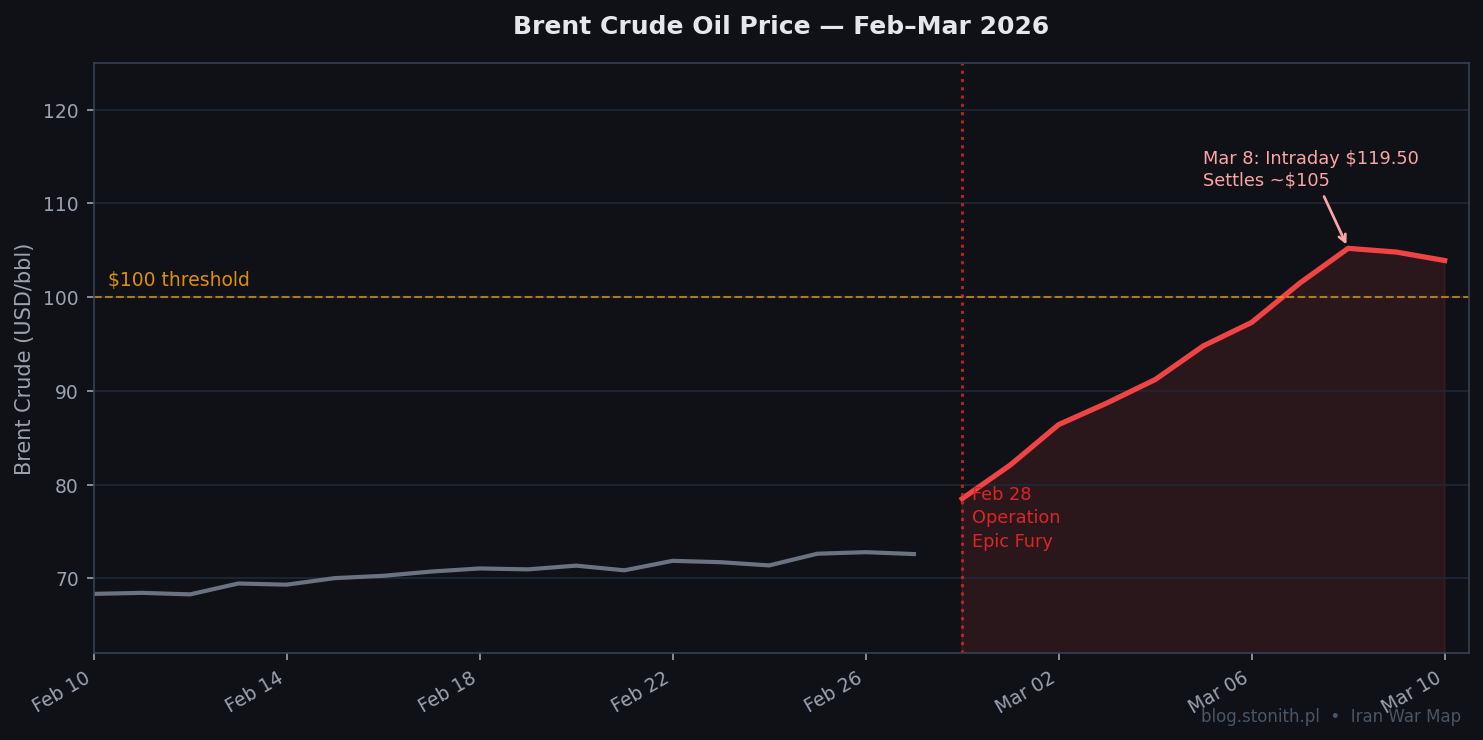
Brent crude spiked to $119.50/barrel intraday — above $100 for the first time since Russia’s 2022 Ukraine invasion — settling around $105. WTI hit $119.48 before falling to ~$102. Cumulative price increase since February 28: approximately 50%. Dow futures fell 1,000 points. The Washington Institute assessed Iran had “achieved greater success halting Hormuz commercial shipping” than in any prior Strait closure crisis.
The Minab Revelation
NPR and CBS reported Bellingcat’s geolocation confirmation: a Tomahawk cruise missile — a US weapon not used by Israel — had struck a compound in Minab, southeastern Iran. The compound had formerly housed an IRGC naval base; it had since been converted to include a girls’ school and a clinic opened in 2025 by IRGC Commander-in-Chief Hossein Salami. Seven buildings were struck.
Iranian state media reported 165–180 deaths. A preliminary US intelligence assessment cited by CBS estimated 168 killed, describing most as “school children.” Six Democratic senators issued a joint statement. Defense Secretary Hegseth’s response: “The only side that targets civilians is Iran.”
The US assessment acknowledged American responsibility as “likely,” attributing the strike to potentially outdated targeting intelligence — the base-to-school conversion apparently not reflected in US targeting databases. The Minab incident was the single largest civilian death toll in a US/Israeli strike of the conflict and the most serious domestic political challenge to continued war authorization to that point.
US Response: Trump Threatens, State Dept Evacuates
Trump, in an ABC News interview: “He’s going to have to get approval from us. If he doesn’t get approval from us, he’s not going to last long” — referring to Mojtaba Khamenei’s selection.
Axios reported the first documented US-Israel policy disagreement since the war began: a Trump administration adviser told the outlet “the president doesn’t like the [oil infrastructure] attack. He wants to save the oil.” Israel’s officials publicly defended the strikes as necessary IRGC logistics degradation. The divergence exposed a strategic difference: the US appears to view Iranian economic infrastructure as a postwar asset; Israel is pursuing attrition.
The State Department ordered all non-essential diplomatic staff to depart posts in eight Middle Eastern countries simultaneously: Bahrain, Iraq, Jordan, Kuwait, Lebanon, Qatar, Saudi Arabia, and UAE. Additional drawdown orders covered consulates in Karachi and Adana. 32,000 Americans had returned from the Middle East since February 28.
Sgt. Benjamin Pennington, 26, of Glendale, Kentucky, died of wounds sustained in the March 1 Kuwait port attack — the seventh US service member killed in the conflict.
At 01:00 local time in Oslo, an explosion struck the US Embassy compound. Norwegian police cited a “possible terror motive” in the context of the current security situation. No injuries; no group claimed responsibility.
Structural Assessment
March 8 was the day Operation Epic Fury transitioned from a kinetic war into a systemic crisis on multiple simultaneous tracks. The succession resolved — but “Death to Mojtaba” chants the same night showed the new leader’s domestic legitimacy is contested from the start. The Pezeshkian reversal confirmed, once again, that the IRGC runs Iran’s wartime military policy regardless of what civilian officials say. The Bapco force majeure and oil crossing $100 signaled that the conflict had crossed from the battlefield into the global economy. The Minab revelations put the political cost of continued operations on Washington’s domestic agenda for the first time.
The first crack in the coalition — over oil targeting — was small. But it was the first.
Sources
Mojtaba Khamenei succession
- Al Jazeera — Iran names Khamenei’s son as new supreme leader
- RFE/RL — Iran names Khamenei supreme leader
- Iran International — Mojtaba Khamenei, the shadow prince
- NPR — Israel, Iran, oil, and the ayatollah successor
- NBC News — Iran supreme leader Mojtaba Khamenei
- Washington Post — Mojtaba Khamenei chosen as Iran’s supreme leader
- Jerusalem Post — IDF warns every successor will be pursued
- Times of Israel liveblog — March 8, 2026
IRGC vs civilian government / Pezeshkian
- Al Jazeera — Why Iranian leaders are sending mixed messages on Gulf attacks
- Iran International — Leadership rift exposed
- Iran International — No room to discuss ceasefire
Military strikes / IDF Phase 2
- i24NEWS — IDF eliminates head of Military Office of Supreme Leader
- Critical Threats (ISW/AEI) — Morning special report March 8, 2026
- Alma Center — Daily report March 8, 2026
Toxic rain over Tehran
- TIME — Iran oil strikes Tehran
- Al Jazeera — Israeli attacks on Iran fuel sites
- CEOBS — Black rain: health and environmental risks from Tehran’s oil fires
Gulf state strikes / Bapco force majeure
- Al Jazeera liveblog — March 8, 2026
- CBS News live updates — US-Iran war
- Argus Media — Bahrain’s Bapco issues force majeure
- Arab News — Bahrain state oil firm force majeure
- Long War Journal — Iran strikes Gulf civilian infrastructure March 7-8
- Al Jazeera — Flames engulf Kuwaiti high-rise
Oil prices
- CNN — Oil prices war Iran Trump
- Fortune — Oil prices $100, Dow futures
- Al Jazeera — Oil soars past $100 a barrel
Minab school compound
US response / Trump / diplomatic evacuation
- RFE/RL — Mojtaba Khamenei message to US and Israel
- Axios — US dismayed by Israel’s Iran fuel strikes
- Bloomberg — US orders diplomats to leave Saudi Arabia
- US News — State Department orders drawdown at more Mideast missions
- Times of Israel — US soldier dies of wounds (7th casualty)